have become more energetic
have become less energetic
have become smaller in size
decompose into atoms
start repelling each other
Explanation
Video Explanation
No video available
Post your Contribution
Discussions (25)

Pls pressure is directly pros to temp.uder high pressure gas become more energetic becoz temp increase and they do not obey gas law becoz the force of attraction BTW dem is no longer negligible owing to high pressure

I agree wit U @ Etugo, Temprature is directly proportional to pressure @ constant volume. The answer should be. A

B. is the correct answer because gases behaves as an ideal gas at low pressure and high temperature, so, at high pressure real gases like CO2,O2,etc condenses to form liquid with low energetic power and low collision.
B is the correct ans...under high pressure the molecules become more packed 2geda hence free movement is reduced which also reduce the kinetic energy

The two conditions necessary for a Real gas to deviate from ideal condition are I. High pressure ìí. Low temperature, so from the kinetic energy in relation to temperature, if the temperature is low, the energy will also be low, so B is correct.

I think your wrong @kevskid.
Pressure is directly proportional to temperature with volume constant. So, increase in pressure results in increase in temperature i.e {average kinetic energy}

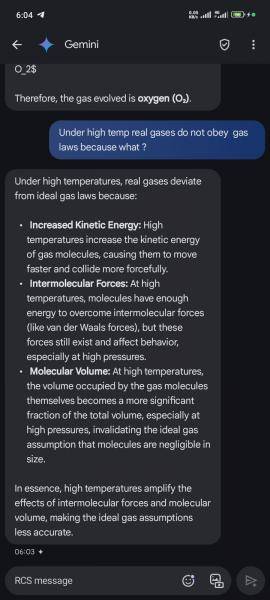
Under high pressure, real gases do not obey the ideal gas law because their molecules are close enough together that intermolecular forces become significant. These forces cause the molecules to attract each other, which is not accounted for in the ideal gas law.
However, none of the options provided directly address this concept. The closest option is **E. start repelling each other**, but it's not entirely accurate because under high pressure, gas molecules generally attract each other, not repel. So, the correct answer would be **None of the above** if there was an option that stated "molecules start attracting each other". But based on the given options, **E. start repelling each other** is the closest, albeit not entirely correct.
adding light to what Sammy said, if the intermolecular forces are more significant now then they are getting more of liquid features ( less energetic), so the option is correct