Breathing roots for entry air
flowers are raised above water to attract pollinators
spongy tissues containing gases for boyancy
hairy structures on the leaves to reduce water loss
Explanation
No explanation available
Video Explanation
No video available
Post your Contribution
Discussions (11)

B. flowers are raised above water to attract pollinators.
This is not an adaptation because it is not a heritable trait that has evolved over time in response to natural selection. Rather, it is a characteristic that is more likely the result of the way in which the plant's developmental program has evolved. In other words, it is a byproduct of the plant's physiology rather than an adaptation that has evolved specifically to enhance the plant's fitness. The other features mentioned in the options are adaptations.
Flowers are raised above water to attract pollinators is not an adaptation. This is a structural feature that may aid in pollination, but it is not a heritable trait that has evolved over time in response to selective pressures. The other options listed are adaptations that have evolved in different plant species to help them survive in their environments.

None of the features listed is not an adaptation. All of the options represent adaptations that have evolved in different organisms to help them survive and thrive in their environment.
A. Breathing roots for entry air is an adaptation found in some aquatic plants that enables them to obtain oxygen from the air.
B. Flowers raised above water to attract pollinators is an adaptation found in some aquatic plants that helps ensure pollination by attracting pollinators that fly above the water surface.
C. Spongy tissues containing gases for buoyancy is an adaptation found in some aquatic plants that helps them stay afloat and photosynthesize more effectively.
D. Hairy structures on the leaves to reduce water loss is an adaptation found in some plants that helps reduce water loss through transpiration.
Therefore, the answer is None of the above.

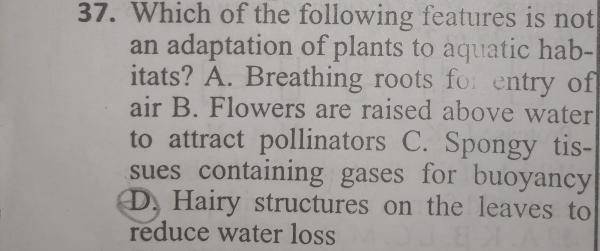
the question is actually complete. following tge past question here the correct answer is "D" since aquatic plants do not need hairy structures on leaves to reduce water loss. that is a feature of xerophytes.
hope this helps
this question answer is wrong and you showing a picture of you ticking it doesn't change anything . Option B is often considered the correct choice in some biological contexts (like specific WAEC or JAMB exams) because it describes a common reproductive strategy rather than a specialized survival modification . unique to a specific extreme environment. In these testing frameworks, a feature might not be classified as an "adaptation" if it is seen as a standard developmental trait or a byproduct of existing physiology rather than a selective structural change for environmental survival.
Why the other options are adaptations
 A. Breathing roots (Pneumatophores): These are structural adaptations found in mangrove plants that allow them to obtain oxygen while growing in waterlogged, anaerobic (oxygen-poor) soils.
C. Spongy tissues (Aerenchyma): This is a specialized tissue with air spaces that provides buoyancy to aquatic plants (hydrophytes) and facilitates internal gas exchange.
D. Hairy structures (Trichomes): These are adaptations found in desert plants (xerophytes) to trap a layer of moist air, reduce air flow across the leaf surface, and thereby minimize water loss through transpiration.


Out of the listed features, the one that is not an adaptation is:
C. spongy tissues containing gases for buoyancy.
Here's why:
An adaptation: An adaptation is a characteristic that has evolved over time and provides an advantage for survival and reproduction in a specific environment. It helps organisms better cope with the challenges of their habitat and increases their chances of passing on their genes.
Breathing roots: Mangrove trees, for example, have developed specialized roots called pneumatophores that grow above the waterlogged soil. These roots allow the trees to breathe by taking in air through pores in their bark. This is an adaptation to their environment, where the soil is often saturated with water, making it difficult for the roots to get enough oxygen through the usual channels.
Flowers raised above water: Aquatic plants like water lilies have flowers that rise above the water surface. This allows them to attract pollinators, such as insects, that cannot swim underwater. This feature increases the plant's reproductive success, making it an adaptation.
Hairy structures on leaves: Some plants, like desert cacti, have developed hairy structures on their leaves. These hairs help to reduce water loss by trapping moisture and creating a barrier against wind. This is an adaptation to their arid environment, where water is scarce.
Now, let's look at spongy tissues containing gases for buoyancy. While this feature might seem like an adaptation that helps some plants stay afloat in water, it's actually a fundamental characteristic of all plants. Most plants have spongy mesophyll tissue in their leaves, which contains air spaces that contribute to gas exchange and photosynthesis. This feature is not specific to aquatic plants and doesn't necessarily provide an advantage for survival in a particular environment. Therefore, it's not considered an adaptation in the same way as the other listed features.
Here are some additional points to consider:
Adaptations can be structural, behavioral, or physiological.
The process of adaptation is driven by natural selection, where organisms with advantageous traits are more likely to survive and reproduce, passing on those traits to their offspring.
Not all features are adaptations. Some may be the result of neutral mutations or constraints in development.
All these comments are funny, the answer is clearly None of the above
all these are adaptations, please confirm answers so as not to spread misinformation. Thank you.

A. Breathing roots for entry of air . This is an adaptation (e.g., mangrove plants use it to get oxygen in waterlogged soil)
B. Flowers are raised above water to attract pollinators
This is an adaptation (helps reproduction)
C. Spongy tissues containing gases for buoyancy
This is an adaptation (helps aquatic plants float)
D. Hairy structures on the leaves to reduce water loss
This is also an adaptation (common in desert plants to reduce transpiration)
Final Answer:
None of the options is correct — because ALL listed features are adaptations.

