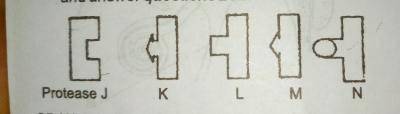
Diagram J is a protease while diagrams K,L,M, and N are food substances, study them and answer this question.
Protease J would react with the particular illustrated substance because enzymes?
are denatured at a high frequency
are specific in their action
remain unchanged after a reaction
speed
Explanation
No explanation available
Video Explanation
No video available
Post your Contribution
Discussions (1)

Based on the information you provided and the image of the five diagrams, the most likely reason why protease J would react with the particular illustrated substance (diagram K) is because:
B. Enzymes are specific in their action.
Here's why:
A. Enzymes are denatured at a high frequency: Denaturing refers to the process where an enzyme loses its shape and function. While some enzymes can be denatured by high temperatures or other factors, this is not a characteristic that makes them react with specific substances.
B. Enzymes are specific in their action: This is the most likely reason why protease J would react with the protein chain in diagram L. Proteases are a type of enzyme that specifically breaks down proteins into smaller molecules like amino acids. The shape and chemical properties of the active site of a protease enzyme determine which types of molecules it can bind to and break down. In this case, the active site of protease J likely has a shape and chemical composition that allows it to bind to and break down the protein chain in diagram L more effectively than the other food substances shown.
C. Enzymes remain unchanged after a reaction: While enzymes do not get used up in the chemical reactions they catalyze, they can change their shape slightly during the reaction. However, they typically return to their original shape and can participate in another reaction. This characteristic doesn't directly explain why protease J would react with the protein chain in diagram L specifically.
D. Enzymes speed up reactions: This is a general characteristic of enzymes, but it doesn't explain why protease J would react with the protein chain in diagram L specifically compared to the other food substances.
Therefore, based on the specificity of enzymes for their target substrates, protease J is most likely to react with the protein chain in diagram L because its active site is a good fit for the protein's structure.
It's important to note that without more information about the specific food substances in diagrams K, M, and N, it's difficult to say definitively whether protease J would not react with them at all. However, based on the general principle of enzyme specificity, the protein chain in diagram L is the most likely candidate for a reaction.

