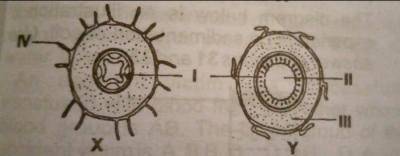
Diagrams X and Y above are illustrations of transverse sections of a part of plants, Study them and answer this question.
The part responsible for conducting water and dissolved mineral salts from the soil to the leaves is labelled
I
II
III
IV
Explanation
No explanation available
Video Explanation
No video available
Post your Contribution
Discussions (12)

The answer is root hairs not xylem. Xylem is is a vascular tissue that conducts water and mineral salt from the root to the leaves But root hairs with the help of cell sap takes up water and mineral salt from the soil and it transport it to the vascular tissue (xylem) in the root and xylem takes it up from the root to the leaves the rest of the plant
from left to right is, first image is a section of a dicot root and the second a section of monocot root.
I-xylem(responsible for conduction of water and dissolved mineral salts from the to the leaves)
II- Pith
III- ground tissue of cortex
IV- root hairs
Answer is A

The phloem is a tissue that transports organic nutrients, such as sugars, throughout the plant. It is composed of tube-shaped cells called sieve tubes that are connected by tiny pores called plasmodesmata. The sugars are actively transported into the sieve tubes at the source (such as the leaves), and then passively move down the concentration gradient to the sink (such as the roots).
The xylem, labeled B. II, is another type of vascular tissue that transports water and dissolved mineral salts from the roots to the leaves. However, the xylem is not responsible for conducting organic nutrients.
The other parts of the diagram are:
A. I: The epidermis is the outermost layer of cells in the plant. It protects the plant from water loss, disease, and pests.
D. IV: The pith is the central part of the stem. It is made up of parenchyma cells, which are a type of plant cell that stores food and water.

