toxins released into the blood as a result of the destruction of red blood cell
the multiplication of the malaria sporozites in the liver
the invasion of the red blood cells by the trophozoites
the development of merozoites into gametocytes
Explanation
Video Explanation
No video available
Post your Contribution
Discussions (27)


The selected answer is wrong:
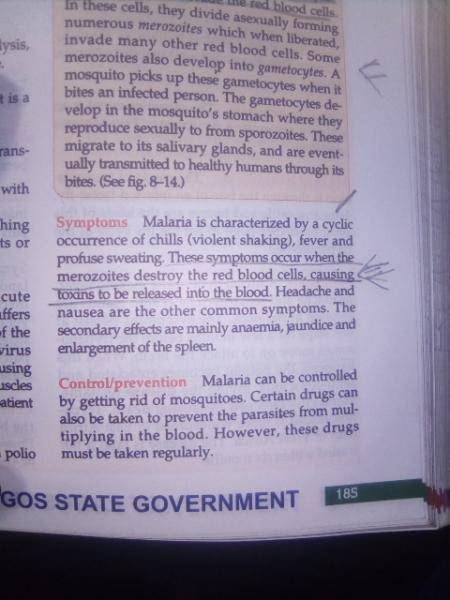
"the symptoms occur when the merozoites destroy the red blood cells, causing toxins to be released into the blood" ...the correct option is A not B.
REF: check: modern biology by Ramalingam page 185

A is the answer.. The fever and chills of malaria are associated with the rupture of erythrocytic-stage schizonts
A is correct
from the textbook:
"these symptoms occur when the merozoites destroy the red blood cell,causing toxins to be released into the blood.
from this ..i think a is correct
Myschool A is correct
Ref: Modern biology pg 18
Malaria symptoms occur when merozoites destroy the red blood cells causing toxins to be released in the blood

When the female anopheles mosquito takes a blood meal it's injects sporozytes into the bloodstream then enters the liver invade hepatocytes and form merozoites back then enters the red blood cell. In the red blood cell it undergoes series of reactions from ring form to trophozoites then to Schizonts, the schizonts forms More merozoites then the red blood cell burst, as the result of red blood cell burst the merozoites is released, TN factor and inflammatory cytokines is released too resulting to symptoms of malaria such as fever Malaise
so the answer is correct.
pathogenesis of maleria
My school is correct biko.
Malaria symptoms are caused by the Plasmodium parasite, which is transmitted through the bite of an infected Anopheles mosquito.
When an infected mosquito bites a person, it injects the parasites into the bloodstream. The parasites then travel to the liver, where they multiply and develop into a form that infects red blood cells.
The parasites inside the red blood cells multiply and cause the cells to rupture, releasing more parasites into the bloodstream...
so you can actually see that they go straight to the liver where they multiply and develop into a form that affects the red blood cells.

The correct answer is A. toxins released into the blood as a result of the destruction of red blood cells.
Malaria symptoms, such as fever, chills, and flu-like symptoms, are caused by:
- The release of toxins, like hemozoin, when red blood cells are destroyed by the malaria parasite.
- The immune system's response to the infection.
The other options are not directly responsible for causing malaria symptoms:
- B. Multiplication of sporozoites in the liver is an early stage of the parasite's life cycle.
- C. Invasion of red blood cells by trophozoites is a step in the parasite's life cycle, but it's not the direct cause of symptoms.
- D. Development of merozoites into gametocytes is a stage in the parasite's life cycle, but it's not related to symptom production.
Malaria is caused by a parasite. It is passed to humans by the bite of infected Anopheles mosquitoes. After infection, the parasites (called sporozoites) travel through the bloodstream to the liver. There, they mature and release another form of parasites, called merozoites. The parasites enter the bloodstream and infect red blood cells (RBCs).The parasites multiply inside the red blood cells. The cells then break open within 48 to 72 hours and infect more red blood cells. The first symptoms usually occur 2 to 4 weeks after infection, though they can appear as early as 8 days or as long as a year after infection. The symptoms occur in cycles of 48 to 72 hours.

So first, the question is asking: what causes the symptoms of malaria. That’s the key: it’s not asking how you get malaria, it’s asking why people actually start feeling sick—like fever, chills, headaches, sweating, body aches, sometimes vomiting.
Let’s start with the malaria parasite itself. The parasite is called Plasmodium, and there are different species, like Plasmodium falciparum and Plasmodium vivax, but the life cycle is kind of the same. When a mosquito bites you, it injects sporozoites into your blood. These sporozoites travel to your liver.
Now, look at option B: “the multiplication of malaria sporozoites in the liver.” In the liver, yes, the parasites multiply. But here’s the thing—they do this quietly. You don’t feel sick yet. The liver stage is asymptomatic. Your body doesn’t notice anything wrong at this point. So, even though the sporozoites are multiplying, this isn’t what’s causing the fever or chills. So B is not the answer.
Next, option D: “the development of merozoites into gametocytes.” Merozoites are the stage that comes out of the liver and start infecting red blood cells. Some of them later become gametocytes, which is the stage that mosquitoes pick up when they bite you. This is important for transmission, so the disease can spread from person to mosquito to person. But gametocytes themselves do not make you sick. They’re just for the parasite to continue its life cycle. So D is not the answer either.
Option C: “the invasion of red blood cells by trophozoites.” Trophozoites are basically the form of the parasite that lives inside red blood cells. When a red blood cell is invaded, the parasite feeds on it, grows, and eventually multiplies. This starts to cause some damage, but the real trigger for the symptoms is what happens next.
Finally, option A: “toxins released into the blood as a result of red blood cells.” This is the one. Here’s why: after the trophozoites grow inside the red blood cells, they burst the cells open. This releases a bunch of parasite waste and parts of the broken red blood cells into your bloodstream. These act like toxins. Your body’s immune system reacts strongly to this sudden release. That reaction is what causes the fever, chills, sweating, headaches, and general malaise. Every time the parasites complete a cycle in the red blood cells and burst them, the symptoms flare up, which is why malaria often comes in cycles of fever spikes.
So in simple terms, the symptoms are not caused by the parasite being in your liver or becoming gametocytes. It’s caused by the destruction of red blood cells and the release of toxic substances into your blood. That’s why A is correct.
I know all these words like trophozoite, merozoite, sporozoite feel like nonsense right now, but if you picture it like this: a mosquito injects tiny seeds (sporozoites), they hide and multiply quietly in the liver, then they burst into your blood and hijack red blood cells. When the red cells explode, your body screams in fever and chills—that’s the malaria symptom. That’s the core idea you need for JAMB.
. toxins released into the blood as a result of the destruction of red blood cells 
Here’s why:
Malaria is caused by the Plasmodium parasite.
After being injected into the human bloodstream by a mosquito, sporozoites first go to the liver, where they multiply. This stage (option B) is usually asymptomatic.
The symptoms of malaria—fever, chills,
sweating, headache—arise when merozoites are released from red blood cells, causing them to rupture.
When red blood cells are destroyed, toxins from the parasites (and the breakdown products of the red blood cells) enter the bloodstream. These toxins trigger the characteristic malaria symptoms.
Options C and D describe processes in the parasite lifecycle, but they do not directly cause the symptoms.
My school should correct it


Which organ does malaria attack first?
Image result for how do malaria attack the body
The life cycle of malaria parasites. Sporozoites are introduced by a mosquito bite. They migrate to the liver, where they multiply into thousands of merozoites. The merozoites infect red blood cells and replicate, infecting more and more red blood cells.
B is the answer for those that are confused

