each daughter cell gets the necessary organelles
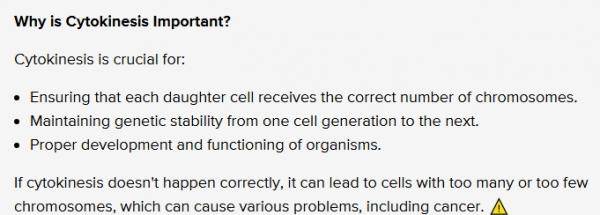
there is distribution of a complete set of genes into each daughter cell
daughter cell inherit new genetic combinations
worn out organelles are excluded from daughter cells
Explanation
Video Explanation
No video available
Post your Contribution
Discussions (8)

Cytokinesis simply means the splitting of the Cytoplasm of a parent cell into two daughter Cytoplasms. And mitosis here implies the splitting of (not the cytoplasm) the nucleus of the cell. What am trying to say is that, while mitosis deals with the splitting of the nucleus, cytokinesis deals with the splitting of the cytoplasm. Now the cytoplasm can be imagined as a membrane, or a medium, or a fluid in which all the internal cell organelles float.

Cytokinesis is the final process in eukaryotic cell division, which divides the cytoplasm, organelles, and cellular membrane. It is the part of the cell division process during which the cytoplasm of a single eukaryotic cell divides into two daughter cells.
The "goal" of mitosis, which includes cytokinesis, is to make sure that each daughter cell gets a perfect, full set of chromosomes. Cells with too few or too many chromosomes usually don’t function well.
Therefore, the correct answer is **B. there is distribution of a complete set of genes into each daughter cell**. This is because cytokinesis ensures that each daughter cell receives an equal and full set of chromosomes¹. However, it's important to note that while cytokinesis does involve the division of the cytoplasm and organelles, it does not inherently ensure that each daughter cell gets the necessary organelles (option A), nor does it exclude worn out organelles from daughter cells (option D). Also, cytokinesis does not result in new genetic combinations (option C); that is a feature of meiosis, not mitosis¹..