reduction in the number of stomata
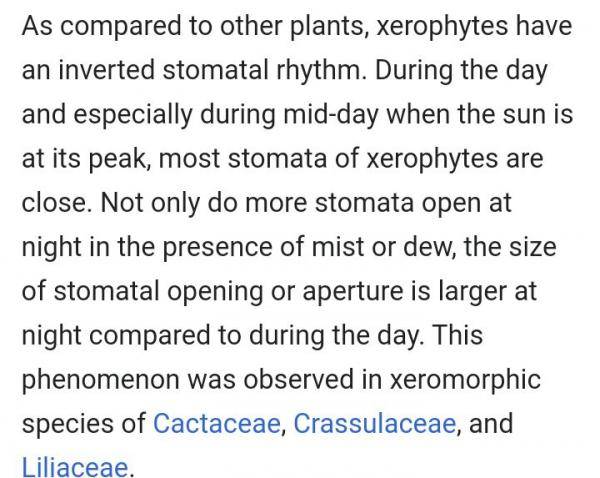
reversal of the normal stomatal rhythm
possession of shallow roots
possession of waxy cuticles
Explanation
Video Explanation
No video available
Post your Contribution
Discussions (22)

You guys are all getting this wrong. Let's brush through again. The question says a PHYSIOLOGICAL adaptation. This means the physically expressed features made by a plant to excessive water loss. The answer should be D. Ok so you mean to tell me that if you were to find yourself in a practical exam and you were asked to list some physiological/ observable features of specimen A-Fish. Will you say "it has intestine" abi "it has a brain divided into several parts"? No. It should be things like "possession of scales" or "possession of fins". I don't know if you get what I mean but I just want us to take every information we are given into consideration. Remember they said "physiological".
I'd like to hear what you guys have to say on my suggestion. After all we are learning.
In deserts for instance, succulent plants store water in fleshy leaves, stems or roots. All cacti are succulents, as are such non-cactus desert dwellers as agave, aloe, elephant trees, and many euphorbias.
A stomata is a tiny opening or pore that is used for gas exchange. They are mostly found on the under-surface of plant leaves. Air enters the plant through these openings. Several other adaptations such as reversal of the normal stomatal rythm are essential for a desert plant's water storage to be effective.


Option d is a structural adaptive feature hence option b is the correct answer note the key word PHYSIOLOGICAL which focuses more on the internal structures of the organism hence option b fits the description while option a is more a physical feature

The correct answer is **D. Possession of Waxy Cuticle**. A waxy cuticle is a protective layer covering the leaves, young shoots, and fruits of many plants. It serves as a barrier to water loss and is one of the key adaptations that helps plants prevent excessive water loss. The cuticle is composed of a polymer called cutin and other plant-derived waxes that are synthesized by epidermal cells. The specific composition and thickness of the cuticle vary according to plant species and environment. Other adaptations to reduce water loss include having a reduced surface area, possessing leaf hairs (trichomes) that trap water vapor, and having stomata located in pits on their leaves.