phosphorus
calcium
iron
potassium
Explanation
Video Explanation
No video available
Post your Contribution
Discussions (28)

The correct answer is A. Phosphorus.
.
.
Phosphorus is immobile in soils with appreciable colloid content because it tends to be tightly BOUND to these tiny particles.
REF: http://organiclifestyles.tamu.edu/soilbasics/plantessential.html

I think, if plants was added to the question that ehich is more bound to plants it would be iron
The correct answer is:
A. Phosphorus
Phosphorus is the most bound to the soil because it forms insoluble compounds with calcium (in alkaline soils) or iron and aluminum (in acidic soils). This makes it less available for plant uptake compared to other nutrients like potassium or calcium, which are more mobile in the soil.
Greetings, The Myschool Team.
The correct answer is A(phosphorus) and not C(iron). Phosphorus tends to form insoluble compounds and complexes with different components and minerals present in the soil. Most soil phosphorus is in a non-labile(fixed) or labile form, both of which are not immediately available to plants. While iron is tightly held, it is not as tightly held as phosphorus. Thus, the correct answer is A(phosphorus) and not C(iron). Thank you.

Which mineral salt is most bound to the soil?
The mineral nutrient that is most bound to the the soil is iron.

The correct answer is:
A. phosphorus
Phosphorus is the most tightly bound nutrient in the soil because it forms insoluble compounds with calcium in alkaline soils and with iron and aluminum in acidic soils. This limits its availability to plants.


Why is nobody talking about calcium
Calcium can be found in water as calcium carbonate which is common in the soil
As plants absorb the nutrients from the soil water, the soluble pool is replenished from the surface-bound pool.
...
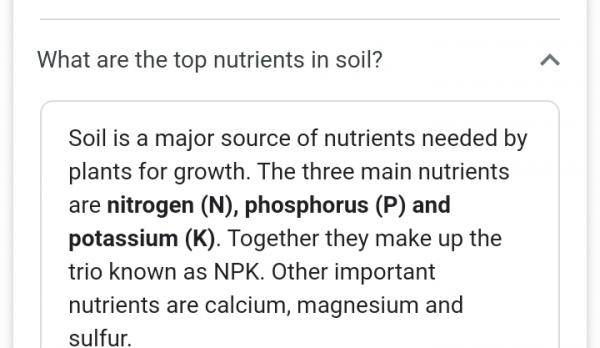
Plant nutrients in soil.
Element
Symbol
Ion or molecule
Iron
Fe
Fe2+, Fe3+ (ferrous, ferric)
Magnesium
Mg
Mg2+
Boron
B
H3BO3, H2BO3 −, B(OH)4 −
Manganese
Mn
Mn2+

