mimicry
countershading
flash colouration
disruptive colouration
Explanation
Video Explanation
Post your Contribution
Discussions (23)

Explanation
Disruptive coloration is a camouflage technique that uses contrasting patterns to break up an animal's outline and make it harder to see.
Countershading is a type of camouflage where an animal's upper body is darker than its underside.
Warning coloration is a defense mechanism used by animals to warn predators that they are toxic, distasteful, or have other harmful qualities.
Cryptic colouration, also known as camouflage, is a defense mechanism that helps organisms hide their identity, location, and movement by blending in with their surroundings. It's a common form of visual camouflage that uses color patterns to make it harder for predators to see the organism.
Mimicry is when an harmless animal resembles a dangerous one to scare off predators
So the answer is not mimicry
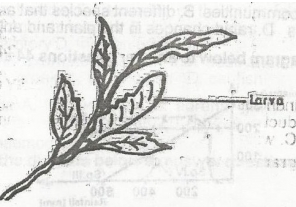
i think its disruptive colouration because in disruptive coloration animals take the pattern of their habitat just as a larva will take the pattern of its habitat

The answer is mimicry
according to wickipedia
it is the resemblance if an organism with another organism
eg. like plant and larvae are two different organisms
Myschool, the answer is A.
please correct this, it is not everyone that cross check answers.
And this will be what they will carry on their skull.
Thanks.



