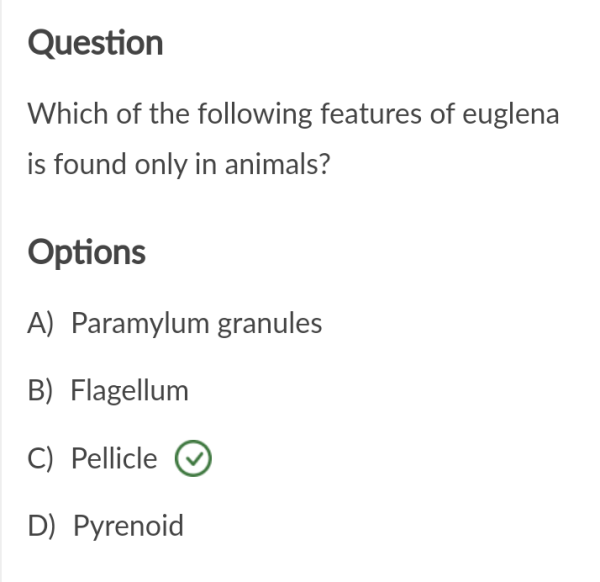
Paramylum granules
Flagellum
Pellicle
Pyrenoid
Explanation
Video Explanation
No video available
Post your Contribution
Discussions (22)


just check ur modern biology textbook, page number 14 under phylum protozoa. precisely the revised 2018 edition

Yes, everyone suggests the ans be B but it clearly isnt. as the question states "found only in animals". flagellum is found in animals but is also found in protists as well as algae like chlamydonomas, which clearly is not an animal. This should.point anyone thinking the ans is pellicle, buh this isnt it either. pellicle are proteinous yes, buh they are not found in animals as stated by the question. pyrenoids and paramylum granules are ruled out as they are invovled in photosynthesis.
my school.... help us it please.


the answer is C
flagellum is also in some bacteria therefore it's not only "unique to animal"
The answer should be flagellum because is the animal like feature found in euglena and it is used for movement or locomotion
The correct answer is:
C. Pellicle
 Explanation:
The pellicle is a flexible, protein-rich layer found in euglena that helps it maintain its shape while allowing movement. This structure is animal-like and replaces the rigid cell wall found in plant cells.
It gives Euglena the ability to move like an animal, using a wave-like motion.
Let's break down the other options:
A. Paramylum granules – Unique to Euglena and plant-like: used to store carbohydrates (like how plants use starch).
B. Flagellum – Found in both animals (like man-fluid cells) and protists; not exclusive to animals.
D. Pyrenoid – Associated with photosynthesis, helps in carbon fixation and starch formation — a plant-like feature.

The correct option is B Flagellum.
Here's why:
* Flagellum: A flagellum is a whip-like appendage that helps with movement. Many animals, like man-fluid cells, use flagella for locomotion. Euglena also use flagella to move, but this feature is not unique to animals.
Let's look at why the other options are incorrect:
* Paramylum granules: These are storage carbohydrates unique to euglena. They are not found in animals.
* Pellicle: This is a flexible protein layer that provides support and shape to euglena. It's not found in animals.
* Pyrenoid: This is a protein-rich structure associated with chloroplasts in euglena, involved in carbon fixation during photosynthesis. It's not found in animals.
Therefore, the only feature listed that is found in animals is the flagellum. However, it's important to note that while some animals have flagella, it's not a feature exclusive to animals. Many protists, like euglena, also have flagella.
It seems there might be an error in the q or the provided answer choice.

