tendency for organisms to over produce
struggle for existence
survival of the fittest
use and disuse of body parts
Explanation
No explanation available
Video Explanation
No video available
Post your Contribution
Discussions (3)


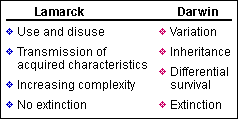
According to Idodo Umeh College Biology, Darwin's theory of organic evolution by natural selection was based on six(6) propositions as follows:
(1) Overproduction,
(2) Struggle for existence,
(3) Offsprings show variation,
(4) Adaptive characteristics,
(5) Inheritance of adaptive characteristics, and
(6) Development of new species.
However, Lamarck's theory of organic evolution were:
(1) the theory of need,
(2) the theory of use and disuse of body parts, and
(3) the theory of acquired characteristics by inheritance.
From the above extract, the answer to the question is clearly Option D, use and disuse of body parts because it is Lamarck's. Thus, D is the answer and the odd one out.
According to Idodo Umeh College Biology, Darwin's theory of organic evolution by natural selection was based on six(6) propositions as follows:
(1) Overproduction,
(2) Struggle for existence,
(3) Offsprings show variation,
(4) Adaptive characteristics,
(5) Inheritance of adaptive characteristics, and
(6) Development of new species.
However, Lamarck's theory of organic evolution were:
(1) the theory of need,
(2) the theory of use and disuse of body parts, and
(3) the theory of acquired characteristics by inheritance.
From the above extract, the answer to the question is clearly Option D, use and disuse of body parts because it is Lamarck's. Thus, D is the answer and the odd one out.

