An homoiothermic animal kept in a room where the temperature is lower than the body temperature may lose heat by four physical process. Which of the following processes is NOT connected with the body temperature regulation ?
Radiation
Sweat
Evaporation
Conduction
Convection
Explanation
Video Explanation
No video available
Post your Contribution
Discussions (41)

the answer is b
you can't sweat when the temperature is below your body temperature
 Ezepue Stephen Chiazam

Conduction is the transfer of heat between objects that are in direct contact with each other. For instance, if a person sits on the cold ground, heat moves from the body to the cold ground. Convection is the transfer of heat by the movement of air or liquid moving past the body. This explains why a breeze across the skin may cool one down, whereas trapping air inside clothing keeps the body warm.
A lizard sunning itself on a rock on a warm summer day illustrates radiation: the transfer of heat energy via electromagnetic waves.
Whereas conduction, convection, and radiation can cause both heat loss and heat gain to the body, evaporation is a mechanism of heat loss only, in which a liquid is converted to a gas. Perspiration evaporating off the skin is an example of this heat loss mechanism.
Read more: http://www.biologyreference.com/Ta-Va/Temperature-Regulation.html#ixzz6aHxJ3WEu
The correct answer is E.
Explanation:
Homeothermic animals is group os animals that includes mammals and birds. These animals maintain a stable internal body temperature regardless of external influence. Radiation, sweating, evaporation and conduction are all processes associated with heat loss in a homeothermic animal.
The question is a bit confusing but here's what I think; they said four physical processes and convection seems not to be a physical process since it takes place in the body when capillaries near the skin surface dilate or constrict and it aids conduction which is one of the physical processes
normally this is technical question....when d temperature is below body temperature,we feel cold and can never sweat.....ansa is OPTION b

there's no way you will sweat under temperature which is lower than the body temperature
the answer is B
myschool please change this
Those of you choosing sweat, hope you know you can't choose sweat and leave evaporation Right?? Lol. Cause they both happen hand in hand.
The correct answer is E please 😌

The process not connected with body temperature regulation from the options provided is E. Convection. In the context of heat loss for a homeothermic animal in a cooler environment, the relevant processes are:
Radiation: Heat loss through infrared rays.
Conduction: Heat loss through direct contact with a cooler surface.
Evaporation: Heat loss through the evaporation of sweat.
Convection: Heat transfer through the movement of fluids (like air or water). While convection can contribute to heat loss, it is not as directly involved in body temperature regulation as the other three in this scenario.
Convection is the process of losing heat through the movement of air or water molecules across the skin. The use of a fan to cool off the body is one example of convection. The amount of heat loss from convection is dependent upon the airflow or in aquatic exercise, the water flow over the skin.
please my school correct it the answer is sweating
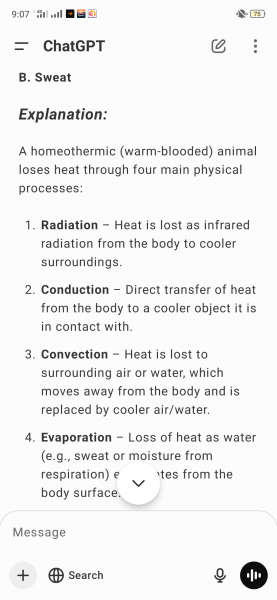
To answer this question, let's analyze how a homeothermic (warm-blooded) animal loses heat in an environment colder than its body temperature.
Heat Loss Mechanisms:
1. Radiation – Heat is lost as infrared radiation from the body to the cooler surroundings. ✅ (Heat loss occurs)
2. Sweating – This process involves the secretion of sweat, which evaporates to cool the body. However, in cold conditions, the body reduces or stops sweating to conserve heat. ❌ (No heat loss)
3. Evaporation – If there is sweat, it evaporates and causes cooling, but since sweating is minimal in the cold, this effect is reduced. ✅ (Possible, but less significant)
4. Convection – Heat is transferred to the surrounding air, which moves away and is replaced by cooler air. ✅ (Heat loss occurs)
5. Conduction – Direct heat transfer occurs when the animal touches a colder surface. ✅ (Heat loss occurs)
Correct Answer:
B. Sweat (Because in cold conditions, sweating is minimized or stopped to conserve heat.)
since someone under low temperature cannot sweat also heat cannot be loss through evaporation since it's the latent heat of evaporation of sweat that cause the cooling effect on the body.....
I'm really confused abt the question. i think we should go for convection....
wen u read regulation of the internal environment.one of d ways of losing heat is through conduction,convection,radiation.through evaporation,especially of sweat so i'm confused.

Homoiothermic animals, also known as endotherms, regulate their body temperature through several processes. These include:
- Radiation: The process of heat transfer from the body to the surrounding environment.
- Sweating and Evaporation: These are cooling mechanisms where heat is lost through the evaporation of water (sweat) from the skin and respiratory tract.
- Conduction: The process of heat transfer from the body to another object or surface that it is in direct contact with.
- Convection: The process of heat transfer from the body to the surrounding air or water.
However, the option B. Sweat is not a physical process but rather a physiological response that aids in the process of evaporation. Therefore, the answer to your question is B. Sweat.