R
S
T
U
Explanation
Video Explanation
No video available
Post your Contribution
Discussions (10)

You've got some good points there! Let's talk it through.
You're right that broad leaves do mean more surface area, and that can lead to more water loss (transpiration). And thin cuticles do mean less protection against water loss.
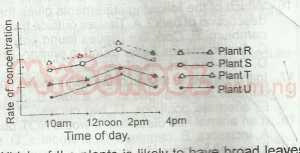
But here's the tricky part about the graph: the "Rate of concentration" they're showing is actually the opposite of water loss.
* High "Rate of concentration" actually means LESS water loss. It's like the water is staying concentrated inside the plant.
* Low "Rate of concentration" means MORE water loss. The water is leaving the plant, so it's less concentrated.
Let's look at Plant R again:
* Plant R has the highest "rate of concentration" on the graph. That means it's losing the least amount of water.
Now let's look at Plant T:
* Plant T has the lowest "rate of concentration" on the graph, especially around midday. That means it's losing the most water.
So, if we're looking for broad leaves and a thin cuticle (meaning lots of water loss), Plant T is the better fit.



