saprophytic
holozoic
chemosynthetic
autotrophic
Explanation
Video Explanation
Post your Contribution
Discussions (16)
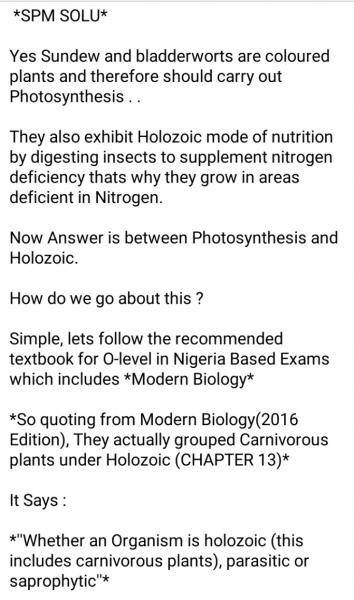


Sundew and bladderwort both possess chlorophyll pigments and therefore can photosynthesis...
Their main mode of nutrition is autotrophic
The modes of nutrition are mainly divided in two, which are, autotrophic and heterotrophic
Autotrophic organisms are divided into two, viz;
1. Holophytic ---> Plants that photosynthesis
2. Chemosynthetic ---> Especially bacteria that break down and oxidize inorganic compounds
Heterotrophic organisms are divided into the following (according to Modern BIOLOGY)
1. Holozoic (animals) ---> Holozoic organisms ingest complex organic food which is digested and assimilated into their bodies
2. Parasitic
3. Saprophytic
4. Carnivorous(plants) ---> Which include pitcher plants, sundew, bladderwort, venus flytrap, butterwort and water fly-trap
5. Symbiotic or mutualistic
From all I've said, sundew and bladderworts are autotrophic as well as holophytic
Secondly, they are hererotrophic as well as carnivorous(insectivorous)... They are not holozoic
OPTION D IS CORRECT... AUTOTROPHIC

The correct answer is:
B. Holozoic
Sundew (Drosera) and bladderwort (Utricularia) are carnivorous plants that capture and digest insects and other small organisms to obtain nutrients, particularly nitrogen, from their prey. This mode of nutrition is classified as holozoic, as it involves ingestion, digestion, and absorption of food, similar to animals.
While they are also autotrophic because they can photosynthesize, their carnivorous adaptation helps them survive in nutrient-poor environments.
Not all green plants photosynthesize
But every plant that photosynthesize have green pigment


they are autotrophic because they both possess chlorophyll alongside taking nitrogen
yeah!those organism feeds parasitically..perhaps parasitism is part of heterotrophic/holozoic nutrition..i suggest..
Sundew and Bladderwort are *autotrophic* (primary producers) with a *carnivorous* supplement. They produce their own food via photosynthesis but supplement their nutrient intake (especially nitrogen and phosphorus) by capturing and digesting insects or small organisms.
- *Autotrophic*: They produce their own food (glucose) through photosynthesis.
- *Carnivorous supplement*: They obtain essential nutrients (like nitrogen, phosphorus) from captured organisms.
So, they're not holozoic (which refers to organisms that ingest and digest solid food particles, like animals). Instead, they're autotrophic with a carnivorous adaptation to thrive in nutrient-poor environments.

The correct option is D autotropic
Sundew is an autotropic and parasitic organism...... It produces it's own food
Likewise bladderwort