


(a) Forces \(F_{1} = \begin{pmatrix} -5 & 4 \end{pmatrix} N; F_{2} = \begin{pmatrix} 2 \\ 5 \end{pmatrix} N; F_{3} = \begin{pmatrix} 2 & -1 \end{pmatrix} N\) and \(F_{4} = \begin{pmatrix} 3 & -5 \end{pmatrix} N\) act on a body. Find the :
(i) resultant of these forces ; (ii) fifth force that will keep the body in equilibrium.
(b) A body moving at 20 ms\(^{-1}\) accelerates uniformly at 2.5 ms\(^{-2}\) for 4 seconds. It continues the journey at the speed for 8 seconds, before coming to rest in t seconds with a uniform retardation. If the ratio of the acceleration to the retardation is 3 : 4,
(i) sketch the velocity- time graph of the journey ; (ii) find t ; (iii) find the total distance of the journey.
(a) An object is thrown up a smooth plane inclined at an angle of 30° to the horizontal. If the plane is 15m long and the object comes to rest at the top, find the :
(i) initial speed of the object ; (ii) time taken to reach the top.
(b) 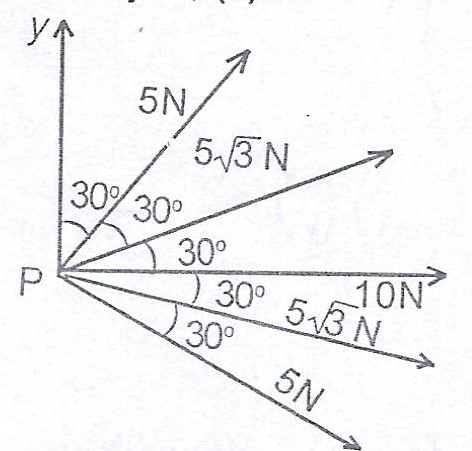
Force of magnitudes \(5 N, 5\sqrt{3} N, 10 N, 5\sqrt{3} N\) and \(5 N\) act on a body P, of mass 5 kg as shown in the diagram. Find the :
(i) magnitude of the resultant force ; (ii) acceleration of the body.


