


(a) A compound of carbon, hydrogen and chlorine contains 0.48 g of carbon, 0.08 g of hydrogen and 1.42 g of chlorine.
(i) Determine the empirical formula of the compound.
(ii) If the molar mass of the compound is 99, calculate the molecular formula of the compound.
[H = 1.0, C = 12.0, Cl = 35.5]
(b) State three properties of NaCl (s) which shows that it is ionic.
(c) Consider the following reaction equation:

(i) On the same diagram, sketch and label a reaction profile for a catalysed and uncatalysed reaction between H\(_2\) and O\(_2\).
(ii) Indicate the possible positions of the activated complexes for the reaction profiles in (c)(i).
(d) The petrochemical industry produces addition polymers using one of the fractions obtained from crude oil.
(i) Name the fraction used as a raw material for the process.
(ii) What process is used to obtain the fraction from crude oil?
(iii) Name two gaseous hydrocarbons that can be used in making polymers.
(iv) Describe briefly how these hydrocarbons can be obtained.
(v) Name the polymer produced from one of the hydrocarbons named in (d)(iii).
a) (i) Describe, using the kinetic theory of matter, what happens when potassium chloride dissolves in water.
(ii) Give a reason why the process in (a) (i) is endothermic.
(b) (i) An underground iron pipe is less likely to corrode if it is bonded at intervals with magnesium rods. Give reasons for this observation.
(ii) State the stages involved in the rusting of iron.
(iii) State the condition for the rusting of iron in water.
(c) (i) What is a spontaneous reaction?
(ii) State two conditions that could make a reaction spontaneous.
(iii) Explain briefly why one gramme of sodium reacts more rapidly with water at 250C than one gramme of calcium at the same temperature.
(iv) Write equations for the reactions in (c)(iii).
(d) What mass of lead (II) trioxocarbonate (IV) would contain 35.0 g of lead?
[C=12.0, O = 16.0, Pb = 207.0]
(e) Name the type of intermolecular force present in:
(i) fluorine;
(ii) hydrogen fluoride.
(a) Outline the procedures for the treatment of water for town supply.
(b) (i) State two main impurities present in bauxite.
(ii) Give one reason why bauxite is usually preferred as the ore for the extraction of aluminium.
(iii) Outline the manufacture of aluminium form purified bauxite.
(c) (i) Explain briefly the term fine chemical industry.
(ii) State two differences between a fine chemical and a heavy chemical.
(d) (i) Write a balanced chemical equation for the combustion of coal.
(ii) If 5.4 g of coal is burnt completely, calculate the amount of oxygen measured at s.t.p. that would be required for the combustion.
[C = 12.0, O = 16.0, Molar volume of a gas at s.t.p. = 22.4 dm\(^3\)]
(e) Name two substances which can be used as electrodes during the electrolysis of acidified water.


(a) (i) List two gaseous pollutants that can be generated by burning coal.
(ii) Explain briefly why coal burns more easily when it is broken into pieces than when it is in lumps.
(iii What gas is responsible for most of the explosions in coal mines?
(iv) Name the non-volatile residue left behind after the destructive distillation of coal.
(b) State one oxide in each case which:
(i) is used in bleaching;
(ii) oxidizes hot concentrated HCl to chlorine;
(iii) dissolves in water to give a solution with pH greater than 7;
(iv) reacts with NaOH and also with HCl;
(v) is a reddish-brown gas.
(c) (i) Write a balanced chemical equation for the reaction between chlorine gas and iron(II) chloride solution.
(ii) State the type of reaction in (c)(i).
(iii) Give a reason for your answer in (c)(ii).
(d) Consider the following set-up:
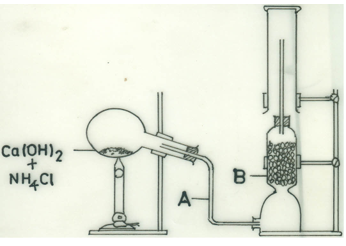
(i) Identify A and B.
(ii) Write a balanced chemical equation for the reaction.
(iii) Name the gas produced.
(iv) Why was the flask tilted downwards?
(v) What is the:
(I) function of B in the experiment;
(II) method of collection of the gas?
(e) Give one product obtained from refining petroleum that is solid.
The periodic table is an arrangement of elements according to their?
