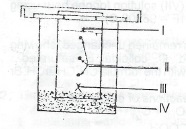
The set-up shown in the diagram below was used to separate a drop of universal indicator into the constituent dyes using ethyl ethanoate as the solvent.
(a) What name is given to the separate strated in the diagram?
(b) State: (i) how many components are resolved in the separation;
(ii) the material normally used in laborary as the adsorbent medium;
(iii) which of the labels the point of application of the indicator.
(ii) a major raw material for the plastic industry.
(b) Write the structural formula of the hydrocarbon in (a)(i) above. Name the process by which it can be converted to neoprene rubber.
(c) Potatoes contain a high proportion of carbohydrate.
(i) Give the main product formed when potatoes are dehydrated completely
(ii) Describe how you would convert potatoes to ethanol. State the reactions involved the process and write equation for the final stage of the conversion.
(iii) Draw a labelled diagram of the apparatus you would use to obtain a sample of fairly pure ethanol from the product formed in (c)(ii) above. What is the name given to the technique?
(a) Give three differences between electrovalent compounds and covalent compounds
(b) List two physical properties of metals which can be accounted for by their structure
(c) Thorium (Th) metal undergoes a reaction represented by the following equation:
\(^{234}_{90}Th \to X + ^{234}_{91}Pa\)
(i) State the type of process involved in the reaction
(ii) Balance the equation equation and hence identify X.
(iii) Name one equipment which can be used to detect X.
(iv) Sketch a curveto show the mass of given quantity of thorium will change over a long period of time.
(d) Y is a moderately reactive divalent found naturally in the combined state as the trioxocarbonate (IV) salt, YCO\(_3\) is decomposed by strong heat, state the steps you would use in extracting Y from the ore. Write equation to show the chemical processes involved.