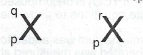
(ii) Consider the reaction represented by the following equation:
N\(_2\)O\(_{4(g)}\) 2NO\(_{2(g)}\)
Night yellow dark brown
State what would happen to the vapour density of N\(_2\)O\(_4\) as the temperature of the system is increased. If the system is cooled, would the gases become lighter or darker in colour? Explain your answer in each case.
(b) Explain the following observations:
(i) an inflated balloon that was left in the sun. burst after some time;
(ii) a pure sample of a liquid did not have a constant boiling point at the top and at the base of a high mountain
(c)(i) List two gaseous reducing agents
(ii) Write one equation each to illustrate the reducing property of the gases you listed in (c)(i) above.
(a)(i) List two uses of aluminium and state how each use is related to the properties of the element.
(ii) State the reason why aluminium oxide is said to be amphoteric.
(b) Calcium is extracted by the electrolysis of fused calcium chloride containing about one-sixth of its mass of calcium fluoride.
(i) Sketch and label the cell used for the extraction.
(ii) Write equations for the reactions at the electrodes.
(iii) State the role of the calcium fluoride in the extraction.
(c) W, X, Y and Z represent four metals which have the following properties: W does not react with cold water but it liberates hydrogen from steam; X is one of the products formed when its trioxonitrate (V) decomposes on strong heating; Z forms the oxide when heated in air and it displaces W from an aqueous solutions of a salt of W; Y tarnishes rapidly exposure and reacts vigorously with cold water. Use the information provided to deduce the order of reactivity of the metals.


 2NO\(_{2(g)}\)