Post UTME Past Questions Agent
Post-UTME Past Questions - Original materials are available here - Download PDF for your school of choice + 1 year SMS alerts

1992 WAEC Chemistry Theory (a)(i) State three differences between electrovalent compound and covalent compound. (ii) Name the type of...

Chemistry
WAEC 1992

(a)(i) State three differences between electrovalent compound and covalent compound.

(ii) Name the type of chemical bonding involved in the formation of ammonium ion from ammonia.


(b)(i) Name the quantum numbers which define an electron within an atom.

(ii) State the orbital in which the fifth electron of an atom is most likely to be found. Sketch the shape of the orbital.

(iii) State the period and the group to which the element boron belongs in the Periodic Table.


(c)(i) What is meant by the entropy of a chemical system?

(ii) Calculate the free energy change for a given reaction at 300 K using the following data obtained for the reaction: \(\Delta\) = -710KJ mol\(^{-1}\); \(\Delta\)S = 0.15 KJ mol\(^{-1}\)K\(^{-1}\)

(iii) From your evaluation in (c)(i) above, state whether the reaction is spontaneous or not at the given temperature. Give reason for your answer.

Post UTME Past Questions Agent
Post-UTME Past Questions - Original materials are available here - Download PDF for your school of choice + 1 year SMS alerts
WAEC and NECO CBT Software for Computers and Laptops - Candidates, Schools, Centres, Resellers - 100% Offline -Download Now
Explanation

(a)(i)

Electrovalent compounds 

Convalent convounds

The compound is made up of an aggregate of ions of opposite charges.

Can conduct electricity as electrolyte.

Can dissolve in water.

Made up of molecules

Cannot conduct electricity

Can only dissolve in organic solvents such as ether.


(ii) Coordinate or the active bond.


(b)(i) The principal quantum number, angular momentum quantum number, Magnetic Orbital quantum number and magnetic spin quantum number.

(ii) The 2 p-orbital group 3A and period two
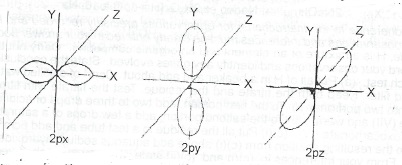
(c)(i) The measure of the degree of disorderliness or randomness of a chemical system.

(ii) \(\Delta\) G = \(\Delta\) H - T\(\Delta\) S = -710 - 300(0.15) = -710 - 45 = -755 KJ/mol

(iii) The reaction is spontaneou because \(\Delta\) G is negative.


Report an Error Ask A Question Download App
WAEC and NECO CBT Software for Computers and Laptops - Candidates, Schools, Centres, Resellers - 100% Offline -Download Now
Your School's Whatsapp Group - Join Us now
WAEC and NECO CBT App for Mobile Devices - Candidates, Schools, Centres, Resellers - 100% Offline -Download Now

Contributions ({{ comment_count }})

Please wait...

{{ settings.no_comment_msg ? settings.no_comment_msg : 'There are no comments' }}

Quick Questions

Post your Contribution

Please don't post or ask to join a "Group" or "Whatsapp Group" as a comment. It will be deleted. To join or start a group, please click here

{{ quote.posted_by.display_name }}
{{ settings.form_textarea_description }}
 
WAEC and NECO CBT Software for Computers and Laptops - Candidates, Schools, Centres, Resellers - 100% Offline -Download Now
Post-UTME Past Questions - Original materials are available here - Download PDF for your school of choice + 1 year SMS alerts
Your School's Whatsapp Group - Join Us now
Post UTME Past Questions Agent
WAEC and NECO CBT App for Mobile Devices - Candidates, Schools, Centres, Resellers - 100% Offline -Download Now
Your School's Whatsapp Group - Join Us now
Post-UTME Past Questions - Original materials are available here - Download PDF for your school of choice + 1 year SMS alerts
WAEC and NECO CBT App for Mobile Devices - Candidates, Schools, Centres, Resellers - 100% Offline -Download Now
WAEC and NECO CBT Software for Computers and Laptops - Candidates, Schools, Centres, Resellers - 100% Offline -Download Now
